 +91 8248827895 |
  absolutevitalhealth@gmail.com
 Joint Pain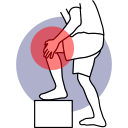
Osteoarthritis knee joint
Osteoarthritis knee joint
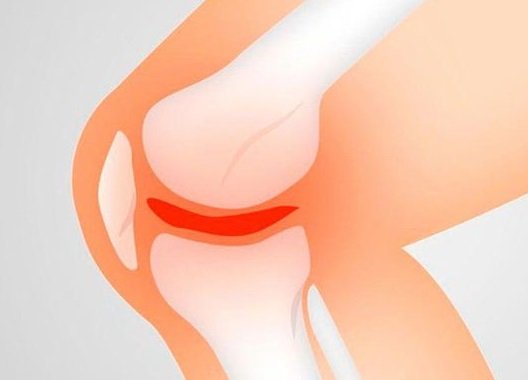
Osteoarthritis of the knee happens when cartilage in your knee joint breaks down. When this happens, the bones in your knee joint rub together, causing friction that makes your knees hurt, become stiff or swell. Knee pain is the most common symptom of osteoarthritis in the knee, making it painful for you to jog, run, climb stairs or kneel.
Osteoarthritis (OA) of Knee joint is the MOST COMMON cause of Knee pain with prevalence rate of 28% in India, causing chronic pain & disability. This chronic pain and disability can be prevented by diagnosis at early stages of arthritis.
- Clinical examination
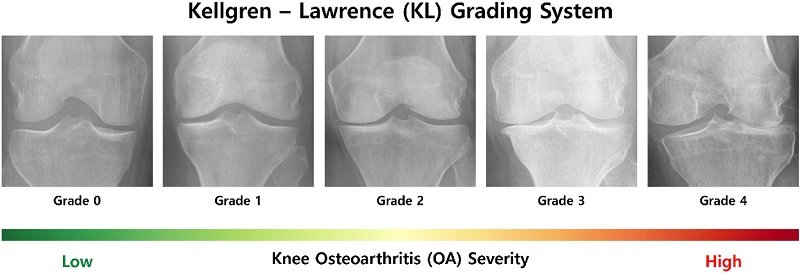
- Radiographic criteria (Kellgren-Lawrence KL-grading) is considered gold-standard.
- Information on the periarticular soft tissue structures which are the first to get affected can be studied only with MRI
- Ultrasonography (USG) is safe, inexpensive & less time consuming which is readily available at the pain clinic
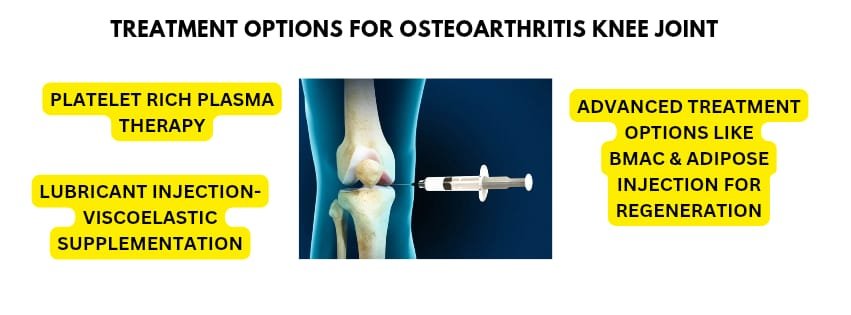
WHAT IS VISCOSUPPLEMENTATION?
Viscosupplementation is a treatment for knee osteoarthritis where a gel-like substance, hyaluronic acid (HA), is injected into the knee joint.
How it works:
HA is a natural component of synovial fluid, which lubricates and cushions the knee joint. In osteoarthritis, the cartilage in the knee breaks down, leading to reduced HA and pain and stiffness.
Viscosupplementation aims to replace this lost HA, restoring lubrication and shock absorption.
The effects of viscosupplementation may not be immediate, and pain relief may take several weeks or months.
The number of injections required varies depending on the specific product and the individual’s condition
Box 2 | Diagnostic criteria for knee OA
Presence of knee pain and three or more of the following
characteristics:
- 50 years of age
- Morning stiffness that lasts for <30 minutes
- Crepitus on active motion
- Bony tenderness of the knee
- Bony enlargement
- No detectable warmth
- >50 years of age
- Morning stiffness that lasts for <30 minutes Crepitus on active motion and osteophytes
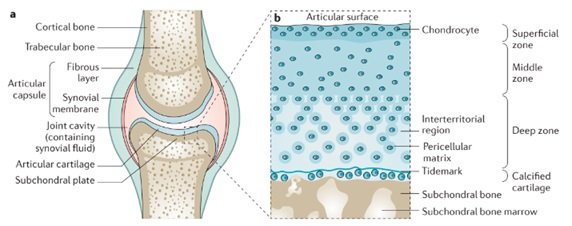
- Water: Makes up more than 70%.
- Collagen: Type II collagen provides strength.
- Proteoglycans: Mainly aggrecan, which helps retain water and gives the cartilage its resilience.
- Collagen Network: Provides tensile strength, allowing the cartilage to withstand stretching and pressure.
- Proteoglycans: Attract water and help the cartilage compress and rebound, making it effective at absorbing shock.
- Avascular: Lacks blood vessels, relying on surrounding tissue for nutrients.
- Aneural: Contains no nerves, so it doesn’t feel pain.
- Chondrocytes: The only type of cell found in cartilage, responsible for maintaining the cartilage matrix.
Changes in Cartilage Composition and Structure in OA
- Degradation: The balance between production and breakdown of matrix components (like collagen and proteoglycans) shifts, leading to loss of these essential components.
- Loss of Water: As proteoglycans decrease, the cartilage loses its ability to retain water, affecting its shock-absorbing properties.
- Fissures and Thinning: The cartilage may develop cracks and become thinner, reducing its protective function.
You can wear out or damage your knee joint cartilage if:
- You’re overweight. If your body mass index (BMI) is 30 or more, you’re seven times more likely to develop osteoarthritis in your knee than someone with a lower BMI.
- You injure your knee or have an old knee injury.
- You frequently put stress on your knee at your job or playing sports.
- You inherited a tendency to develop osteoarthritis of the knee.
- You have crooked bones or joints, such as having knocked knees.
SYNOVIUM
1. Synovial Membrane:
- A thin layer of cells that lines the joint cavity.
- Acts as a semipermeable barrier, regulating the movement of molecules in and out of the joint.
- Synovial Fluid:
- Produced by the synovial membrane, this fluid contains essential nutrients and lubricating substances.
- Key Components:
- Lubricin: A protein that helps reduce friction.
- Hyaluronic Acid: A type of glycosaminoglycan (GAG) that contributes to the viscosity and lubricating properties of the fluid.
- Key Components:
- Nutrient Supply: Provides nutrients to the cartilage, which lacks a direct blood supply.
- Lubrication: The lubricating factors in the synovial fluid create a low-friction environment, allowing smooth movement of the joint surfaces.
Synovitis is the inflammation of the synovium, often seen in osteoarthritis (OA).
Characteristics of Synovitis- Hyperplasia: Thickening of the synovial membrane due to an increase in cells.
- Lymphocyte Infiltration: Involves the presence of T lymphocytes and B lymphocytes, which are types of immune cells that contribute to inflammation.
LIFESTYLE MODIFICATION
QUADRICEPS STRENGTHENING EXERCISES
REGENERATIVE THERAPY
Frequently Asked Questions
Pain management treatments such as Regenerative therapy injections are completely safe and approved by the US FDA. In Absolute Vital Health, we give utmost priority to the safety of the patient.
When knee pain is severe enough to need surgery but the patient isn't ready due to age, health issues, or personal choice, Absolute Vital Health offers non-surgical management of knee pain. In advanced knee pain clinics, RFA is done which offers meaningful relief for severe knee arthritis. A needle is placed near the small nerves around the knee that carry pain signals. These nerves are then lesioned using radio waves (heat energy), so they can no longer send pain messages to the brain. The knee itself is not touched or repaired only the pain pathway is interrupted